How to Avoid Counter Rates in 2026: The Complete Guide
TL;DR
Counter rates are the retail prices you pay when you walk into a UPS Store, FedEx Office, or Post Office and ship a package without a pre-printed online label. They are the most expensive rates any carrier charges, often 25% to 89% higher than commercial rates available online. You can avoid counter rates by buying labels through shipping software, using USPS Click-N-Ship, or simply printing a label at home and dropping the package off. With 2026 rate increases pushing shipping costs 14-16% higher than late 2025, avoiding counter rates matters more now than ever.
Compare carrier rates side by side before your next shipment to see what you could save.
What Are Counter Rates?
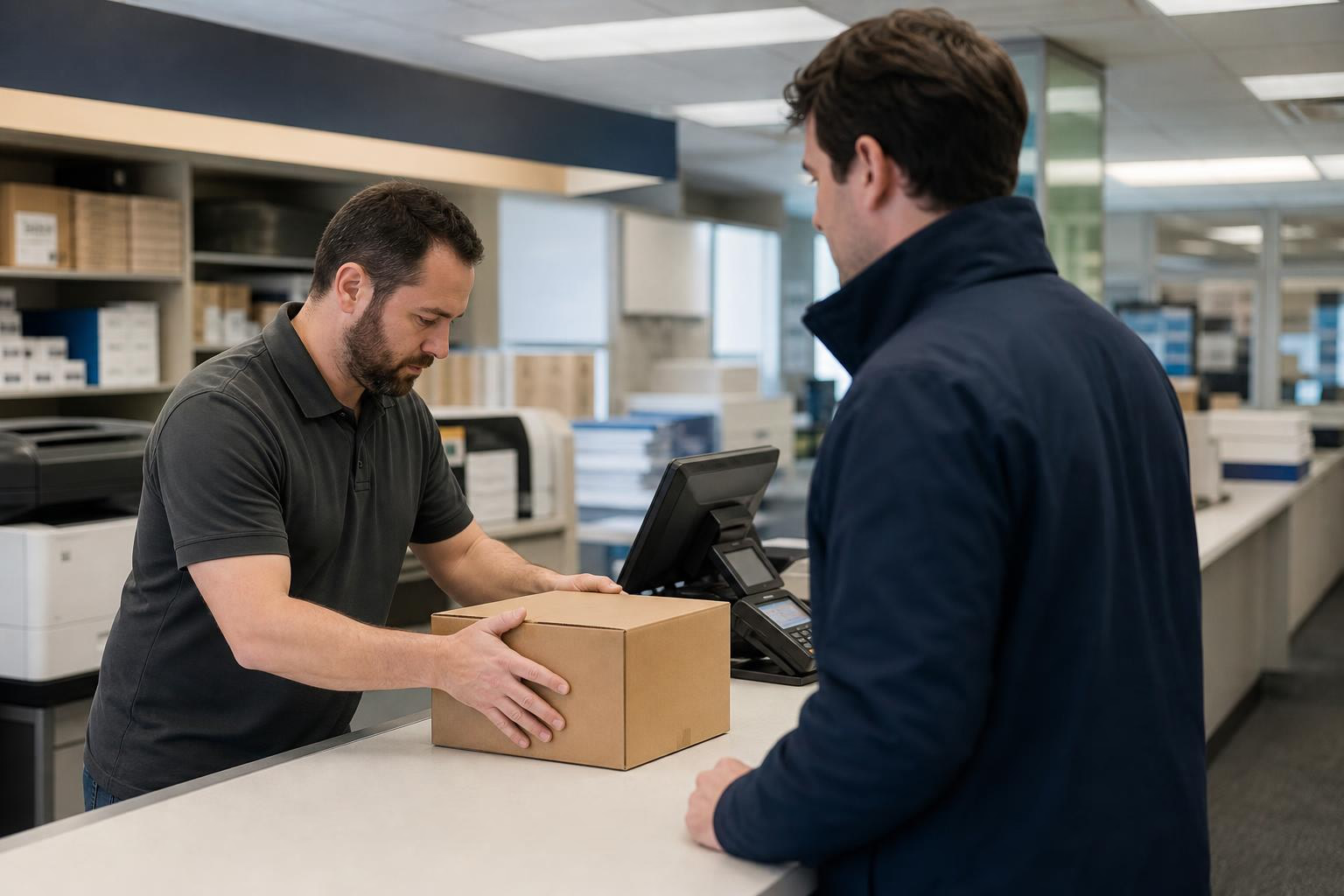
Counter rates, also called retail rates or walk-in rates, are the standard prices a carrier charges when you ship a package at a physical location without a pre-printed online label or business account. If you walk into a UPS Store with a box and ask them to ship it, you’re paying counter rates. Same thing at FedEx Office or your local Post Office window.
These are the highest published rates any carrier charges. They exist because the carrier (or franchise operator) is providing a full-service experience: weighing your package, entering the destination, printing the label, and handling the transaction. That convenience has a steep price tag.
Counter rates apply at three main types of locations:
- UPS Stores (independently owned franchises that mark up UPS rates to cover rent, wages, and profit)
- FedEx Office and FedEx Ship Centers (similar markup structure)
- USPS Post Office counters and kiosks (no franchise markup, but still significantly higher than commercial pricing)
The term “counter rates” is sometimes used interchangeably with “list rates” or “published rates.” Regardless of what you call them, the point is the same: they’re the prices designed for people who haven’t taken the simple steps to access cheaper options.
Counter Rates vs. Commercial Rates: The Price Gap
The difference between counter rates and commercial rates isn’t a rounding error. It’s often the difference between spending $50 and spending $170 on the same package.
USPS: Three Pricing Tiers
USPS structures its pricing into three distinct tiers:
- Retail — what you pay at the Post Office counter, a kiosk, or even USPS.com without a business account
- Commercial Base (CBR) — discounted rates available through USPS.com Click-N-Ship and approved shipping software
- Commercial Plus (CPR) — even deeper discounts, historically requiring shipping volume but now accessible through certain approved platforms
The savings are substantial. Small businesses can save 25% to 89% off retail USPS shipping rates by using commercial base pricing. The 25-45% range covers most Priority Mail and Ground Advantage shipments, while savings can reach 60-89% on specific weight-and-zone combinations where retail pricing is steepest. Commercial Plus pricing adds another layer, saving 20% to 40% compared to retail counter rates.
For a deeper breakdown of how USPS structures these tiers, see our USPS rates and pricing guide.
UPS: Retail, Daily, and Negotiated
UPS has its own pricing ladder. Retail rates are what you see posted at UPS Stores. Daily rates are slightly lower and available through UPS.com with an account. Negotiated rates, reserved for businesses with shipping volume, offer the deepest discounts.
The UPS Store adds its own markup on top of UPS retail rates. Because each UPS Store is an independently owned franchise, it needs to cover commercial rent, employee wages, utilities, and business insurance. That franchise model means customers pay 10-50% more than direct UPS shipping.
Here’s a concrete example: the minimum charge for a 5-pound UPS Ground package is $11.76 at retail versus as low as $10.10 at the daily rate. That’s a modest gap for a small package, but the percentage difference grows dramatically with size and distance.
FedEx: Retail vs. Discounted
FedEx follows a similar pattern. A practitioner example illustrates the gap: a 1-pound package shipped via FedEx Priority Overnight to Zone 8 costs $153.02 at standard retail rates, while a One Rate Medium Box for the same service costs $95.10. That’s a $58 difference on a single package.
A Simple Comparison
| Scenario | Counter/Retail Rate | Online/Commercial Rate | Savings |
|---|---|---|---|
| USPS Priority Mail (avg.) | Full retail | Commercial Base | 25-45% |
| USPS Ground Advantage (heavy) | Full retail | Commercial Base | Up to 32% |
| UPS Store (26 lb package) | ~$170 | ~$50 (UPS.com label) | 71% |
| FedEx Priority Overnight (1 lb, Zone 8) | $153.02 | $95.10 (One Rate) | 38% |
These aren’t theoretical numbers. They come from real transactions, which brings us to what actual shippers report.
What Real Shippers Pay at the Counter
Forum discussions are full of stories from people who learned the hard way how expensive counter rates can be.
On BrownCafe (a forum frequented by UPS employees), one user reported going to the UPS Store to ship a 26-pound package measuring 51x20x10 inches. The store quoted $170. The same user then created a shipping label on UPS.com and paid just $50.
On Yelp, a user wanted to ship a guitar. The online quote came back at $63.40. The local UPS Store wanted $214.00, nearly four times the online price.
Practitioners on AnandTech forums shared similar experiences with international shipments. One user needed to ship an item overseas: the UPS website quoted $220, but the local UPS Store quoted $305.
A UPS insider on BrownCafe explained the mechanics: “The UPS Store has a shipper account with UPS that allows it a discount versus what you can get on UPS.com. So when you ship with the UPS Store, the difference between that price and the discount is the profit.”
In other words, the UPS Store buys shipping at a discount and sells it to you at a markup. You’re paying for their profit margin on top of what’s already an inflated retail rate.
Understanding how shipping costs are calculated helps explain why these gaps exist and how to spot them before you overpay.
Why Counter Rates Are Even Worse in 2026
Counter rates have always been the most expensive option. But in 2026, multiple rate increases have stacked on top of each other, making the penalty for paying retail more painful than ever.
- UPS announced a 5.9% average general rate increase effective December 22, 2025.
- FedEx announced a matching 5.9% average increase effective January 5, 2026.
- USPS Ground Advantage retail rates rose 7.8% on average effective January 18, 2026.
- On April 26, 2026, USPS layered a time-limited adjustment of roughly 8% on top of the January increase.
Cumulatively, most USPS rates are running 14-16% higher than late 2025. And that’s before surcharges, which can add 30-50% to your final bill according to industry analysis.
There’s another change coming. USPS is moving to a 139 dimensional weight divisor (down from 166) effective July 12, 2026. This closes a dimensional weight advantage USPS held over UPS and FedEx, meaning lightweight but bulky packages will cost more across the board.
UPS and FedEx residential delivery surcharges now sit at $6.45-$6.95 per package following the 2026 rate increases. Since counter transactions almost always involve residential deliveries, these surcharges compound the already high retail pricing.
For a detailed look at how UPS and USPS rates compare in the current environment, our UPS vs. USPS rate comparison breaks down the numbers.
5 Ways to Avoid Counter Rates
The good news is that avoiding counter rates is straightforward. Every method below takes minutes to set up and can save you anywhere from 25% to 89% per shipment.
1. Buy Labels Online Through Shipping Software
This is the single most effective way to avoid counter rates. Shipping platforms like Pirate Ship, Shippo, ShippingEasy, and ShipStation connect to carrier APIs and pull commercial rates that are dramatically lower than retail pricing.
Buying labels online through a shipping platform can save 40% to 60% compared to retail. Even for a single shipment, the savings are worth the five minutes it takes to print a label at home.
Qualification for commercial pricing is easier than it used to be. You don’t need volume commitments or special contracts. Simply sign up with an approved shipping platform and start saving with your first label. Practitioners in the reseller community on Reddit put it clearly: “Use Pirate Ship if you’re serious about reselling, running a small business, or simply want the best USPS discounts.”
See current shipping discounts available through online platforms.
If you’re new to printing labels, our guide on how to print a shipping label at home walks through the process step by step.
2. Use USPS Click-N-Ship
USPS states directly: if you’re using Priority Mail Express, Priority Mail, or USPS Ground Advantage, you can ship online with Click-N-Ship and get lower commercial rates. No third-party software required.
Click-N-Ship is free to use. You create a USPS.com account, enter your package details, pay online, and print the label. The rate you pay is automatically the commercial base rate, not the counter rate.
For occasional shippers who don’t want to sign up for shipping software, this is the simplest path to avoid counter rates with USPS.
3. Print the Label Online, Drop Off at the Store
Here’s the part many people miss: you can create discounted shipping labels online and still drop them off at a UPS Store, FedEx Office, or Post Office. You get online pricing combined with the convenience of a physical drop-off location.
When you walk into a UPS Store with a pre-printed label, you’re not paying the store’s markup. You already purchased the label at the lower rate. The store simply accepts the package.
Users on forums specifically advise avoiding the UPS Store for purchasing labels: “Avoid the ‘UPS Store’ and other places that are NOT UPS itself. They’re contractors who charge a fee over and above what the actual shipping cost would be.” But dropping off with a pre-printed label? That’s fine. You can also look for shipping centers near you that accept drop-offs without markups.
UPS Customer Centers (distinct from UPS Stores) provide drop-off locations without franchise markups, though hours and locations are more limited.
4. Use Flat-Rate Options
Flat-rate services eliminate the guesswork of counter pricing and are especially useful for dense, heavy packages shipped long distances. The main options are:
- USPS Priority Mail Flat Rate (small, medium, and large boxes at fixed prices regardless of weight or destination)
- UPS Simple Rate (flat pricing by box size)
- FedEx One Rate (similar structure to UPS Simple Rate)
Flat-rate shipping won’t always be the cheapest option, but it’s predictable and often beats counter rates for heavy items. Our flat-rate vs. regular shipping comparison helps you figure out when each option makes sense.
5. Schedule a Free USPS Pickup
If you want to avoid counter rates entirely, skip the counter entirely. USPS offers free package pickup from your home or business. You schedule it online, leave the package by your mailbox or front door, and your mail carrier picks it up during their regular route.
This works for Priority Mail, Priority Mail Express, and USPS Ground Advantage packages. Learn how to schedule a free USPS pickup in our step-by-step guide.
Quick Reference: 2026 Retail vs. Commercial Savings by Carrier
| Carrier | Counter Rate Premium | Typical Savings with Commercial/Online Rates |
|---|---|---|
| USPS | Retail tier (highest) | 25-89% savings via commercial base pricing |
| UPS | Retail + UPS Store markup | 10-50%+ depending on service and volume |
| FedEx | Retail at FedEx Office | Comparable to UPS structure |
A note on USPS specifically: the reseller community on Reddit reported that in 2026, USPS Ground Advantage commercial rates for 10-20 lb packages dropped up to 26%, but only for those accessing commercial pricing through platforms. Counter buyers saw the opposite, with retail rates climbing 7.8% in January plus another 8% in April.
The gap between counter rates and commercial rates is now the widest it has ever been.
Compare rates instantly across USPS, UPS, and FedEx to see your actual savings.
When Counter Rates Might Be Acceptable
There are a few narrow situations where paying counter rates is reasonable:
- You have a true one-off shipment and no way to print a label (no printer, no library access, no smartphone app).
- You need professional packing for a fragile or oddly shaped item. UPS Stores and FedEx Office locations offer packing services that may justify the premium.
- You’re returning an item with a prepaid label. There’s no rate difference here since the sender already paid for the label.
- The convenience cost is negligible relative to the item’s value. Paying $15 extra to ship a $2,000 item might not be worth optimizing.
Outside of these cases, avoiding counter rates is one of the easiest ways to cut shipping costs. If you’re running a small business, our small business shipping guide covers the full picture of setting up an efficient, cost-effective shipping workflow.
Frequently Asked Questions
What exactly are counter rates in shipping?
Counter rates are the retail prices you pay when you walk into a UPS Store, FedEx Office, or Post Office and ship a package without a pre-printed online label. They are also called retail rates, walk-in rates, or list rates. These are the highest published rates any carrier charges.
How much more do counter rates cost compared to online rates?
The difference varies by carrier and package, but it’s significant. USPS counter rates run 25-89% higher than commercial rates. UPS Stores charge 10-50% more than direct UPS online rates. Real-world examples show people paying $170 at a UPS Store for a package that cost $50 with an online label.
Why are UPS Store prices so much higher than UPS.com?
UPS Stores are independently owned franchises. They buy shipping at a discount from UPS and sell it to you at a markup to cover rent, wages, utilities, insurance, and profit. The difference between the discounted rate they pay and the retail rate you pay is their revenue.
Can I print a label online and still drop off at a UPS Store or FedEx Office?
Yes. This is one of the best ways to avoid counter rates while keeping the convenience of a physical drop-off. When you bring a pre-labeled package to a UPS Store, you pay nothing extra. The store simply accepts the package.
Do I need a business account to get commercial shipping rates?
Not anymore. Most shipping software platforms (Pirate Ship, Shippo, ShippingEasy) give you access to commercial rates from your first label. USPS Click-N-Ship also provides commercial base rates through a free personal account.
Are counter rates getting more expensive in 2026?
Yes, considerably. USPS retail rates rose 7.8% in January 2026, then another 8% in April 2026, for a cumulative increase of 14-16% over late 2025. UPS and FedEx both implemented 5.9% general rate increases. Counter rates in mid-2026 are the most expensive they have ever been.
What’s the fastest way to avoid counter rates if I need to ship something today?
Go to USPS.com and use Click-N-Ship. Create a free account, enter your package details, pay online, and print the label. You’ll automatically get commercial base rates instead of counter rates. The whole process takes about five minutes.
Is USPS cheaper at the counter than UPS or FedEx?
USPS doesn’t have franchise markups, so its counter rates are generally lower than UPS Store or FedEx Office rates. But USPS retail rates are still 12-32% higher than USPS commercial rates depending on weight. The cheapest option across all carriers is almost always buying the label online regardless of which carrier you choose.