
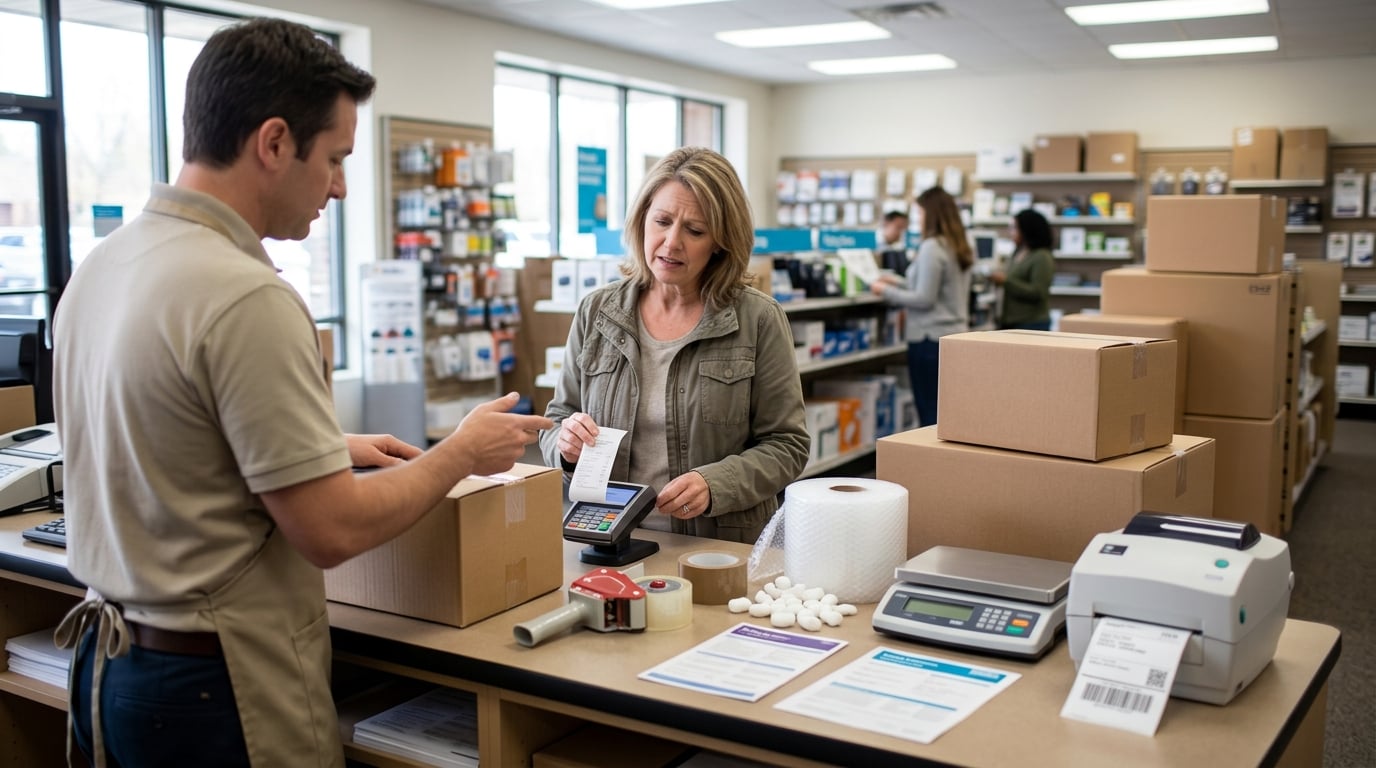
Why Is Shipping So Expensive at Carrier Retail Locations
TL;DR
Shipping at carrier retail locations costs more because you pay published “retail” rates instead of discounted commercial pricing, and the final total includes store-added services like packing materials, labor, label printing, and declared value fees. On top of that, surcharges for residential delivery, dimensional weight, fuel, and delivery area stack onto the base price. You can often save 20% to 50% or more by buying labels online through a shipping platform and skipping the counter entirely.
What “Carrier Retail Locations” Actually Means (and Why It Matters)
Before getting into the cost breakdown, it helps to define terms. Carrier retail locations are the branded, consumer-facing stores where you walk up to a counter and buy a shipping label face to face. The most common examples:
- The UPS Store (independently owned franchises, not operated by UPS corporate). Services and prices vary by location.
- FedEx Office (company-owned locations with standardized pricing for packing and boxes).
- USPS Post Offices (government-operated counters selling retail-priced postage).
When you ship at any of these counters, you pay what carriers call retail rates or published rates. These are the standard, non-discounted price tables that carriers publish for walk-in customers or anyone without a negotiated contract.
The alternative is commercial or online pricing. USPS now offers lower Commercial Rates through Click-N-Ship and approved shipping software. UPS and FedEx offer discounts through account-based pricing or third-party shipping platforms that pass on volume discounts to individual users.
This gap between retail and commercial pricing is the single biggest reason why shipping is so expensive at carrier retail locations. But it’s far from the only one.
The Real Bill: Base Rate + Surcharges + Store Services
Most people assume the number they see on a carrier’s website is what they’ll pay at the counter. That’s rarely the case. The total you pay in-store is actually three charges stacked together:
1. The base transportation charge. This is what the carrier charges to move the package from origin to destination. At The UPS Store, this base rate typically matches what you’d see on UPS.com for the same service, zone, and package dimensions, though it’s the retail published rate rather than a discounted commercial one.
2. Carrier surcharges. Residential delivery fees, fuel surcharges, delivery area surcharges, additional handling charges, and more all layer on top. These apply whether you ship at the counter or online, but many online shoppers don’t realize they exist until they see the counter total.
3. Store-level services and materials. This is where the real surprise hits. Packing labor, boxes, tape, bubble wrap, label printing, and declared value coverage all get added to the receipt. Multiple UPS Store employees on Reddit have confirmed this pattern: “Our store’s base UPS rates are what you’d see on UPS.com; totals climb because customers want us to pack it, add tape, or declare value.” FedEx Office similarly publishes box prices and packing service fees separately from the shipping charge.
Understanding this three-part structure explains most of the sticker shock. The “shipping” price itself might be close to what you expected. It’s everything wrapped around it that inflates the out-the-door total.
For a deeper breakdown of how carriers calculate charges, see our guide to calculating shipping costs.
What Changed in 2026: Rate Increases Hit Retail Customers First
Retail counter prices feel even more expensive in 2026 because of multiple rate increases hitting simultaneously.
UPS and FedEx General Rate Increases (GRIs). UPS’s 2026 GRI averages +5.9% on base rates, but the effective increase runs 10% to 20% once surcharge adjustments are factored in. FedEx followed a similar pattern. These increases apply directly to retail-rate customers who have no negotiated contract cushion.
USPS’s time-limited 8% increase. Approved on March 24, 2026, and effective April 26, 2026, this increase covers Priority Mail, Priority Mail Express, and Ground Advantage at both retail and commercial price levels. Counter customers at USPS Post Offices feel it immediately.
Surcharge inflation outpacing base rates. UPS and FedEx have been raising accessorial fees faster than base transportation charges for several years running. Fuel surcharges fluctuate weekly and are published on carrier websites. Delivery Area Surcharges, Additional Handling fees, and Large Package charges all ticked up with the 2026 GRI cycle. For walk-in customers paying full retail, there’s no buffer.
The net effect: walking into a carrier retail location in 2026 costs meaningfully more than the same trip would have even 12 months ago.
The UPS Store and FedEx Office: What You’re Really Buying In-Store
The UPS Store Franchise Model
A fact that surprises many customers: The UPS Store locations are independently owned and operated franchises, not UPS corporate locations. This means:
- Each franchise owner sets their own prices for services like packing, printing, and materials.
- Policies on what’s included (tape, label printing, box reuse) vary from store to store.
- The base UPS shipping rate generally matches UPS.com for the same service and dimensions, but the add-ons create wide variability in final totals.
Practitioners on Reddit’s UPS Store community report that some stores charge for tape and label printing while others include it. This inconsistency is a major source of confusion and frustration for customers who visit different locations and get different prices.
Pack-and-Ship Guarantees and Declared Value
Both The UPS Store and FedEx Office offer packing guarantees. The UPS Store’s Pack & Ship Guarantee reimburses packing costs, shipping charges, and item value if they pack the item with new materials and ship it on their account. FedEx Office promotes a similar Packing Pledge.
The catch: these guarantees require using the store’s packing services (new materials, their labor), shipping on their account, and often adding Declared Value coverage. Without declared value, reimbursement typically caps at $100.
Declared Value fees add up quickly. UPS charges $5.10 for coverage between $100.01 and $300, then $1.70 per additional $100 above that. FedEx charges $4.95 for the same $100.01 to $300 range and $1.65 per $100 above. For a $500 item, you’re looking at roughly $8 to $9 just for the declared value charge, on top of the packing labor and materials.
This is real value if you’re shipping something fragile or expensive and want peace of mind. But for a $30 item in a sturdy box? The guarantee’s cost may exceed the item’s value.
DIM Weight and “Surprise” Re-Rates: Why Dimensions Matter More Than Weight
Dimensional weight pricing is one of the biggest reasons why shipping is so expensive at carrier retail locations, and it catches people off guard constantly.
Here’s how it works: carriers charge based on the greater of actual weight or dimensional weight. Dimensional weight is calculated by multiplying length × width × height (in inches) and dividing by a standard divisor.
- UPS and FedEx: divisor of 139 for domestic shipments.
- USPS: applies DIM weight only for parcels exceeding 1 cubic foot, and only for Priority Mail and Ground Advantage in Zones 1 through 9.
A practical example: a 12" × 12" × 12" box weighing 5 lbs has a DIM weight of about 12.4 lbs with UPS or FedEx (1,728 ÷ 139). You’d be billed for 13 lbs, not 5. That’s more than double the weight you expected to pay for.
The problem gets worse at the counter because the clerk measures your box precisely. If you got an online estimate based only on weight (or with slightly off dimensions), the in-store price can jump significantly once actual measurements are entered.
Sellers on eBay forums describe receiving $30+ adjustment charges after carriers remeasured packages and found dimensions even slightly larger than what was originally entered. Even a single extra inch can push a package into a higher weight tier or trigger Additional Handling fees.
If you’re trying to compare carriers before committing, compare rates side by side with accurate dimensions, not just weight.
Surcharges That Inflate Walk-In Prices
Beyond the base rate and DIM weight, UPS and FedEx layer on a series of surcharges that can add $10 or more to a single residential shipment. Here are the most common ones that hit retail counter customers:
Residential Delivery Surcharge
UPS and FedEx charge extra to deliver to a home address versus a business. This applies to the vast majority of consumer shipments.
Delivery Area Surcharge (DAS)
Packages going to rural or less-accessible ZIP codes incur an additional fee. Extended DAS areas cost even more. You won’t know this applies until the address is entered at the counter.
Additional Handling
Triggered by packages that exceed certain size or weight thresholds, or by items not fully enclosed in a corrugated box. UPS warns that wrong dimensions or non-standard packaging can trigger these fees. Choosing the right box size matters: see our UPS box sizes guide for reference.
Large Package Surcharge
Packages where length plus girth exceeds 130 inches (UPS) trigger a significant surcharge, often $40 or more.
Fuel Surcharge
Applied as a percentage of the base rate. Both UPS and FedEx update fuel surcharge tables weekly. On a $25 base rate, a 7% fuel surcharge adds $1.75. On a $60 shipment, it’s $4.20.
Address Correction
If the address you provide turns out to be wrong or incomplete, carriers charge a correction fee, typically $15 to $20.
These surcharges apply whether you ship at the counter or online. But at a carrier retail location, they tend to be less visible because the clerk often just gives you a final total without itemizing each charge. The sticker shock feels worse when you can’t see where the money went.
When USPS Retail Can Still Beat Private-Carrier Retail
For small and light packages going to residential addresses, USPS often costs less than UPS or FedEx, even at retail counter pricing. The reason is structural: USPS charges no residential delivery surcharge and no regular Saturday delivery surcharge. That alone can save $5 to $8 per package compared to UPS or FedEx.
USPS also applies DIM weight only on parcels over 1 cubic foot, which means smaller boxes are priced purely by actual weight. UPS and FedEx apply DIM weight to all packages regardless of size.
There are limits to this advantage:
- USPS’s time-limited 8% increase (effective April 26, 2026) narrows the gap on Priority Mail, Priority Mail Express, and Ground Advantage.
- For heavier items (20+ lbs), UPS Ground can sometimes undercut USPS depending on the zone. Check our comparisons for 20-lb packages and 50-lb packages to see the tradeoffs.
- USPS Flat Rate boxes ignore both weight and distance, making them excellent for heavy, compact items. See our flat rate vs. regular shipping guide for a full comparison.
For packages under about 5 lbs going to a home address, USPS retail is almost always cheaper than walking into The UPS Store or FedEx Office, even before considering online discounts.
How to Avoid Paying Retail Counter Prices
Understanding why shipping is so expensive at carrier retail locations is useful. Paying less is better. Here are concrete steps, ranked roughly by impact:
1. Buy Labels Online to Access Commercial Rates
This is the single most effective thing you can do. USPS Commercial Rates are available through Click-N-Ship and approved shipping platforms, no volume minimums required. The USPS Business page states that “all customers save with lower Commercial Rates” online. UPS and FedEx discounts are available through third-party shipping software that aggregates volume across users.
Savings range from 10% to over 50% depending on the carrier and service. Explore discounted shipping options to see what’s available without negotiating a carrier contract.
2. Measure Your Package Before You Go Anywhere
Accurate dimensions prevent surprises. Measure length, width, and height to the nearest inch, rounding up. Calculate DIM weight yourself (L × W × H ÷ 139 for UPS/FedEx) and compare it to actual weight. Use the higher number for your rate estimate.
3. Pack It Yourself
The packing guarantee at The UPS Store or FedEx Office is valuable for fragile, high-value items. For everything else, DIY packing with a correctly sized box and proper cushioning saves $10 to $30 or more. Buy boxes in bulk online for a fraction of what stores charge per box.
4. Skip the Counter Entirely with Pickup Services
USPS offers free Package Pickup from your mailbox or front door when you’ve already purchased a label online. UPS and FedEx offer scheduled pickups as well (often for a small fee or free with an account). No counter visit, no store-level service charges, no impulse add-ons.
5. Choose the Right Box Size
An oversized box doesn’t just waste packing material. It inflates DIM weight and can trigger Additional Handling or Large Package surcharges. Downsizing your box by even two inches in each dimension can drop you into a lower pricing tier.
6. Compare Carriers Before Committing
Don’t assume one carrier is always cheapest. The best option depends on weight, dimensions, origin, destination, and whether the delivery address is residential or commercial. Compare rates across carriers with your actual package specs before choosing.
7. Consider USPS Flat Rate for Heavy, Compact Items
If your item is heavy but fits in a small or medium Flat Rate box, the price is the same regardless of weight or distance. Check current USPS Flat Rate box sizes and prices to see if this works for your shipment.
FAQ
Why was my price at The UPS Store higher than the quote on UPS.com?
The base UPS transportation rate at The UPS Store generally matches UPS.com for the same service, zone, and dimensions. The difference comes from store-added charges: packing materials, labor, tape, label printing, and declared value fees. Since each UPS Store is an independently owned franchise, these service charges vary by location.
Does The UPS Store mark up the actual shipping price?
Based on consistent reports from UPS Store employees, the base shipping rate typically matches UPS published rates for the same specifications. The higher total comes from ancillary services and materials, not a markup on the transportation charge itself. That said, you’re paying the full retail published rate, not a discounted commercial rate.
Is it cheaper to ship at the post office counter or use USPS Click-N-Ship?
Click-N-Ship and USPS-approved shipping software now offer Commercial Rates on many services, which are lower than the retail rates charged at the post office counter. For most small to mid-size packages, buying your USPS label online is cheaper than paying at the counter.
Why do shipping costs keep going up every year?
Carriers implement annual General Rate Increases (GRIs). UPS’s 2026 GRI averages 5.9% on base rates, but surcharge increases push effective costs 10% to 20% higher for many shipments. USPS implemented an 8% time-limited increase effective April 26, 2026. Rising fuel costs, labor costs, and infrastructure investments all drive these increases.
What is dimensional weight and why does it make shipping more expensive?
Dimensional weight is a pricing method where carriers charge based on how much space a package occupies, not just how much it weighs. The formula is length × width × height ÷ 139 (for UPS and FedEx). You’re billed for whichever is greater: actual weight or DIM weight. A large, lightweight box can cost two or three times what you’d expect based on the scale alone.
How can I avoid the residential delivery surcharge?
UPS and FedEx charge extra for home deliveries, and there’s no way to waive that surcharge when shipping to a residential address. Your options are to ship via USPS (which does not charge a residential surcharge), or to ship to a business address or carrier access point when possible.
Are FedEx Office prices the same as FedEx.com?
FedEx Office is company-owned (not franchised like The UPS Store), so pricing is more standardized. However, you still pay retail published rates at the counter rather than commercial rates. And if you use their packing services, box prices and labor charges are added on top. The Packing Pledge provides value if they pack your item, but it’s an added cost.
Is there a way to get discounted shipping rates without being a business?
Yes. Several shipping platforms offer discounted commercial rates to individual users with no volume requirements and no monthly fees. USPS Commercial Rates are available to anyone through Click-N-Ship or approved shipping software. For UPS and FedEx discounts, third-party platforms aggregate shipping volume to pass along lower rates. Check available shipping discounts to see current options.